
RTE, the French electricity transmission system operator, partnered with Quantis to enhance the environmental analysis of its Futurs Énergétiques 2050 scenarios by refining their impact assessment in relationship with nature-related pressures. The project focused on helping quantify impacts on water and land use & effects across electricity generation technologies using a lifecycle approach. Quantis developed a robust analytical framework and datasets to support RTE’s modeling.

Challenge
While RTE had already developed strong capabilities in assessing greenhouse gas emissions and resource needs, integrating water and land impacts into its models brought a new layer of complexity. These impacts are inherently multi-dimensional, highly dependent on technologies, and distributed across the entire lifecycle, from raw material extraction to infrastructure operation and decommissioning.
12 power generation technologies with sub-technologies were assessed:
- Nuclear (EPR, SMR, conventional reactors)
- Thermal – Coal
- Thermal – Oil (fuel)
- Thermal – Natural Gas (CCG, TAC)
- Thermal – Biomass
- Thermal – Biogas / Biomethane / Hydrogen-based gas
- Hydrogen (electrolysis: PEM, SOEC, Alkaline)
- Hydropower (dam, run-of-river, pumped storage – STEP)
- Wind – Onshore
- Wind – Offshore (fixed, floating)
- Solar PV (utility-scale, rooftop, agrivoltaics; mono & polycrystalline silicium cells)
- Batteries (NMCxyz, NCA, LFP cathodes; graphite anodes)
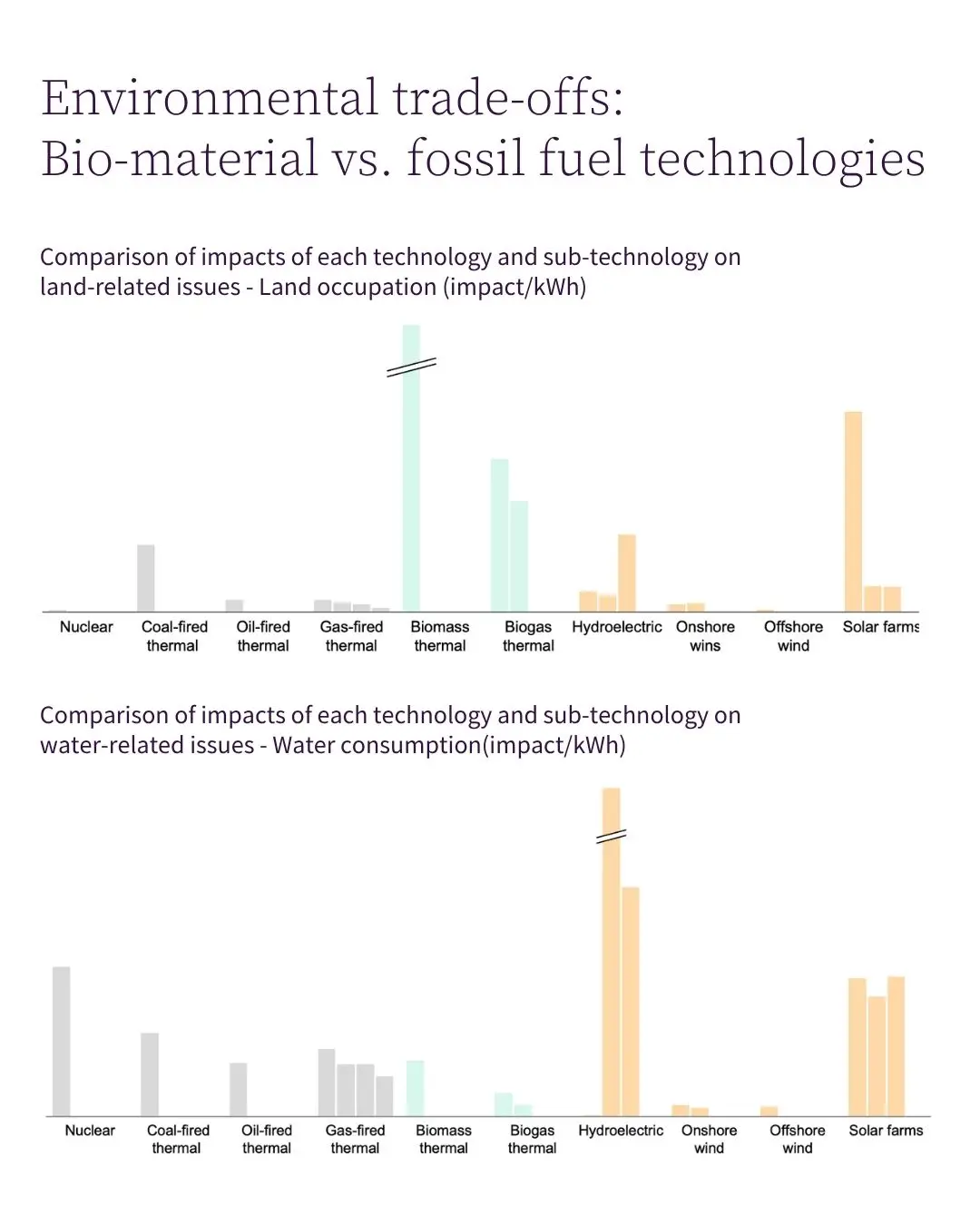
In addition, available data is often fragmented, heterogeneous, and lacks standardization, making comparisons between technologies difficult. As seen in other sectors, assessing environmental impacts beyond climate requires navigating a complex landscape of methodologies, indicators and datasets, while ensuring scientific robustness and usability for decision-making.
RTE therefore needed a structured, science-based approach capable of harmonizing indicators, consolidating data and delivering actionable insights that could be integrated into its internal models.
Solution
To address this challenge, Quantis developed a tailored and structured approach, combining methodological rigor with practical applicability building a framework capable of capturing water and land pressures across the full lifecycle of electricity technologies.
The project began with a detailed alignment phase to define scope, technologies and existing data inputs. Quantis then conducted a comparative analysis of lifecycle assessment methodologies, selecting the most relevant indicators for water and land impacts based on robustness, transparency and decision-making relevance.
Building on this foundation, an extensive bibliographic review was carried out, integrating scientific literature, industry data and recognized LCA databases. This enabled the construction of consolidated and reliable datasets covering multiple technologies and lifecycle stages. Specific focus was brought on data representativity and accuracy.
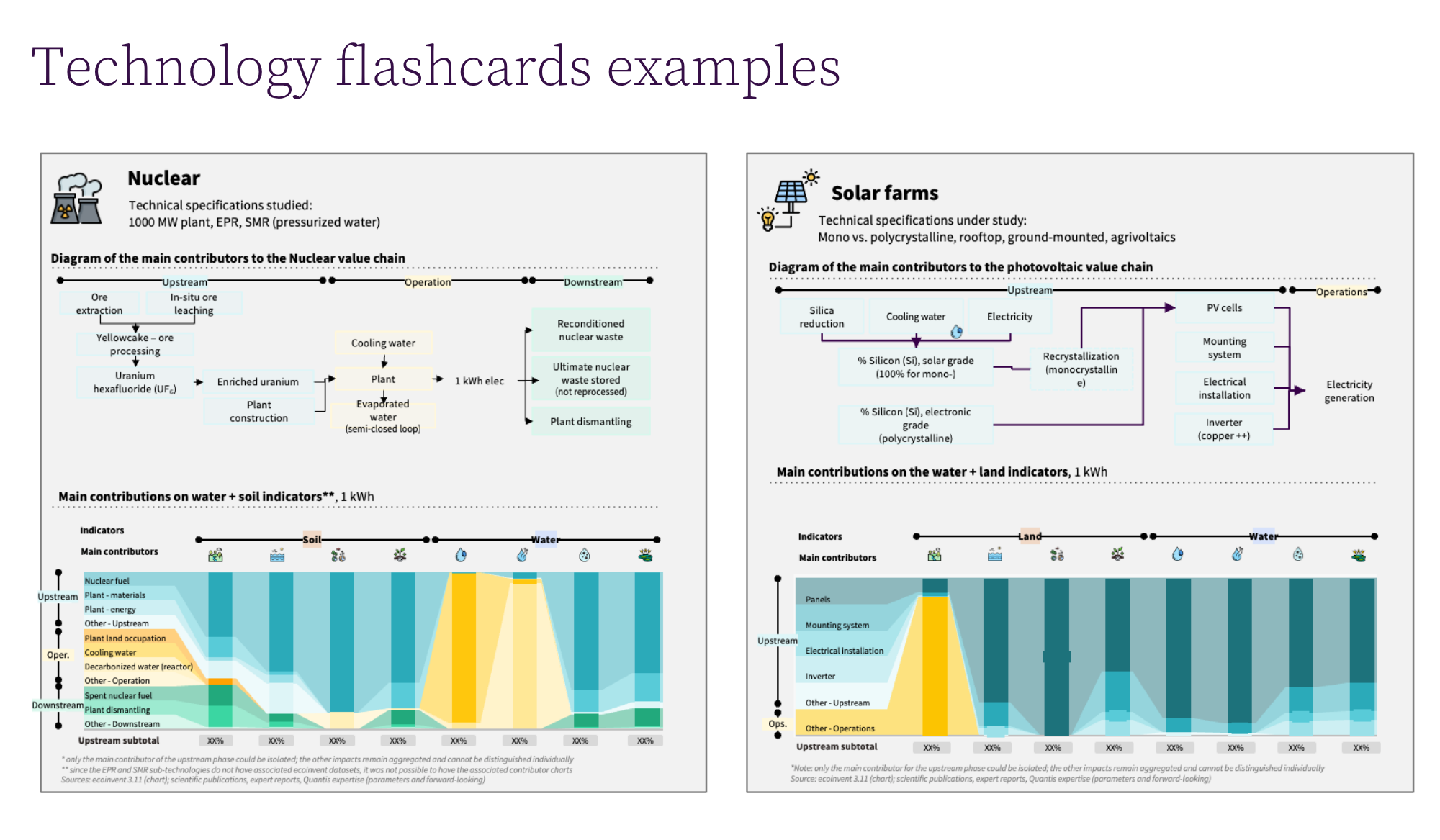
Finally, Quantis translated these insights into a set of standardized technology factsheets, providing a clear and comparable view of impacts, key drivers, uncertainties and future trends. This combination of data, methodology and tools was designed not only to deliver insights, but also to ensure knowledge transfer and long-term usability within RTE’s teams, an essential factor for sustained impact.
Results
This collaboration enabled RTE to significantly strengthen the scientific robustness of the environmental impact assessment of their scenarios by integrating water and land considerations into its analytical framework. By gaining a clearer understanding of where and how impacts occur across technologies and lifecycle stages, RTE is now better equipped to assess trade-offs and guide strategic choices for the energy transition.
Key cross-technology insights (hotspots & remarks) we highlighted:
- Upstream dominates impacts: Across most technologies, most of the water and land impacts come from raw material extraction for infrastructure and/or fuel production, and manufacturing rather than operation.
- Strong trade-offs between water and land: Some technologies can perform well on one dimension but not the other (e.g., low land use but higher water dependence – i.e.: hydroelectricity, or vice versa – i.e.: Photovoltaics), see figure above.
- Materials are a critical driver: Steel, concrete, copper, silicon, and critical metals (e.g., rare earths, nickel, cobalt) are major contributors to impacts, especially for renewables and energy storage.
- Technology design choices matter significantly: Efficiency, cooling systems, technology variants, and siting (e.g., rooftop vs ground PV, generator types in wind) can materially change impact profiles.
- Future impacts depend on overall systemic evolutions: Decarbonization of electricity, improvements in efficiency, and development of recycling and circularity are strongly related to Nature preservation and will be key levers shaping long-term environmental performance.
Beyond the immediate analytical outputs, the project provided RTE with a structured methodology and a harmonized dataset that can be reused and expanded in future scenario updates. It also laid the groundwork for more advanced assessments, including biodiversity and broader nature-related impacts, aligning overall environmental performance with long term strategic planning.
Quantis provided us with a robust flow inventory method, extensive references for water- and soil-related data for the different technologies across their life cycle, and clear synthesis to identify at which stages the main impacts occur. Quantis was very attentive to our feedback and needs throughout the project. The insights gathered in this study will be valuable for updating our life cycle assessment (LCA) models used for the revision of the Futurs Énergétiques 2050 report.
Cécile Saint-Simon, Environmental Analyst, RTE
Ready to align sustainability with business performance?