

In brief:
- Retailers are often perceived as slow on sustainability — not because they lack ambition, but because their progress is shaped by tight margins, consumer behavior and limited control over upstream production.
- Much of retail action happens behind the scenes, in logistics, energy use and supplier engagement, making progress less visible than brand-led product innovation.
- While shifting product mix can reduce emissions, consumer demand constrains how fast retailers can move ahead of the market without risking trust and relevance.
- Retailers’ greatest leverage lies in scale: private label, supplier partnerships and category-level decisions that improve the impact performance of everyday products.
- Data, digital infrastructure, carbon management platforms and targeted use of AI are enabling more consistent measurement, better data sharing and more focused supplier engagement — even in data-constrained environments.
- The strategic challenge is not whether green premiums exist, but where they are unavoidable, where they can be designed out, and where consumers are willing to accept them in exchange for credible value.
- Retailers that treat sustainability as a core business strategy — not a parallel effort — are better positioned to secure supply, manage risk and build long-term competitiveness.
Retailers sit at one of the most visible and scrutinized points of the food system – and increasingly, one of the most exposed. Climate volatility, supply disruption and cost pressure are already reshaping margins, availability and price stability across key categories. However, they are often framed as slower to act in comparison to brands when it comes to sustainability. It’s an easy conclusion to draw — and an incomplete one. Retailers operate under a different set of structural, financial and operational realities than CPGs — realities that shape the pace and form of sustainability progress, but do not eliminate influence. When used deliberately, the levers retailers hold can drive meaningful change across the value chain.
“Retailers aren’t slow, they’re constrained,” says Allon Zeitoun, former CEO of Naturalia and current CEO of Quantis. “For example, from 2015 onward, many French retailers allocated more shelf and promotional space to organic than its revenue share justified. Consumer readiness simply didn’t keep pace with ambition.”
Some retailers are moving, but the challenge — and the opportunity — is to make that momentum visible, scalable and strategically grounded. Increasingly, sustainability is less a parallel effort and more a business strategy: one that shapes cost structures, supply security and long-term profitability. Recognizing these dynamics is the first step toward solutions that work in practice, and toward understanding where retailers can act with clarity and intention in the years ahead.
Why retail progress is harder to see
Most of the sustainability momentum consumers see comes from CPG brands — packaging innovations, product reformulations and certifications. Retailers work differently. Much of their progress happens behind the scenes, in areas such as logistics, refrigeration and food waste reduction. As Allon Zeitoun explains, “Retailers have done a lot in operations — transport, refrigeration — but these aren’t the kinds of improvements consumers notice.”
Many retailers, including Tesco, Carrefour and Walmart, have made measurable gains in these areas. Yet the perception of slow progress persists because retailers’ influence is less visible. Their point of leverage sits at the shelf rather than in production, limiting how clearly upstream action translates to consumers.
Shifting product mix is often seen as retail’s most powerful lever — and at scale, it can deliver meaningful impact. But demand for meat and dairy remains strong in many markets. As long as consumer preferences hold, retailers cannot unilaterally reconfigure shelves without risking relevance and trust. In this context, mix-shift matters but cannot be the sole engine of change.
And yet, retailers remain among the most powerful catalysts in the food system. Their proximity to consumers allows them to shape demand over time — through assortment design, pricing, shelf placement and trusted signals that gradually lower barriers to more sustainable choices.
Understanding the core challenges and opportunities
Retailers understand the stakes — and their role in the food system comes with a distinct set of operating realities. Those realities shape where retailers have leverage today, and where the most meaningful opportunities to act sit.
1. Financial
Retail is a margin game. When inflation hits, costs rise across the board — from logistics to procurement to staffing. But retailers can’t pass all of that on to consumers. There’s a hard ceiling on price increases, especially for staples. As a result, many retailers have seen consumers trade down into private label or lower-cost ranges. This increases price pressure, but it also shifts volume toward products where retailers have more influence over cost, design and margins. In that context, paying a premium for lower-carbon milk or beef without a clear path to recovery remains difficult.
By contrast, CPGs — particularly those with premium brands — can reposition products or launch new lines that build higher prices in from the start. Retailers don’t have that flexibility across the shelf. Every shift is visible at checkout. And with consumer trust in environmental claims still fragile, few shoppers will consistently pay more for “low carbon” unless it comes with tangible benefits such as health or quality.
The opportunity for retailers:
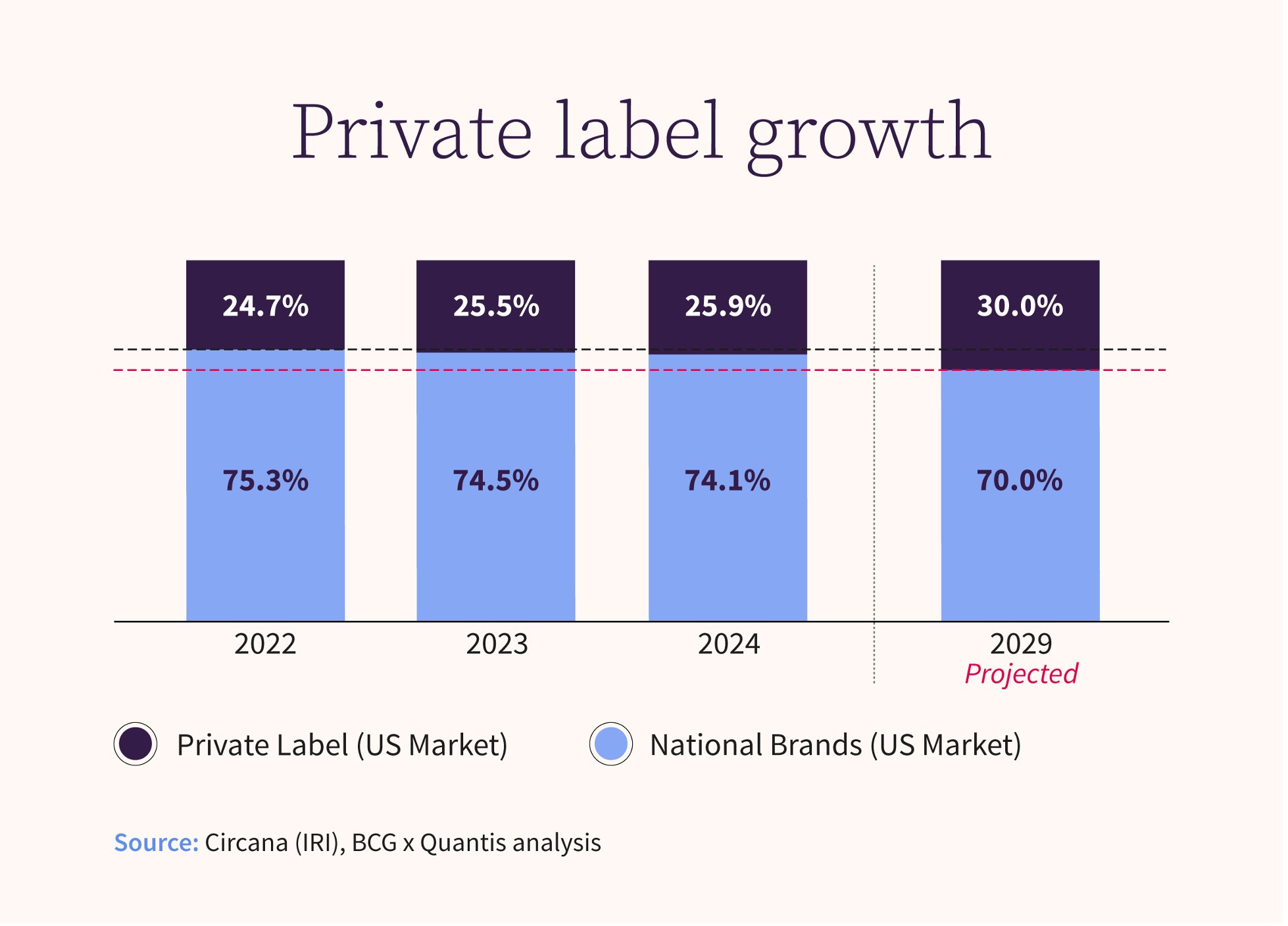
Private label represents one of the strongest growth levers for retailers. For discount retailers such as Lidl or Aldi, it already exceeds 80% of sales. Looking ahead, private label growth is expected to continue over the coming years, pushing unit share beyond 30% and making it a primary driver of retailer growth.
When retailers operate private label ranges, they effectively act as CPGs — with control over product specifications, sourcing choices and cost structures.
This approach is already visible in practice. Some retailers have used private label to develop organic ranges that embed these choices into everyday assortments. In France, Carrefour’s private-label organic range offers one such example, illustrating how organic products can be positioned as part of regular shopping rather than as a premium niche.
By designing private label products for both affordability and lower impact from the outset, retailers can protect margins while scaling more sustainable options across high-volume categories.
- Private label reshapes supplier relationships. Instead of relying solely on price pressure, retailers can co-create programs with suppliers, align on shared metrics and build longer-term partnerships. Where this shift occurs, sustainability becomes more scalable and more credible.
- Private label also reduces exposure to like-for-like comparison, as these products do not compete directly with branded equivalents. When sustainability is designed in from the start rather than added later, innovation is easier to scale and more resilient commercially.
2. Measurement
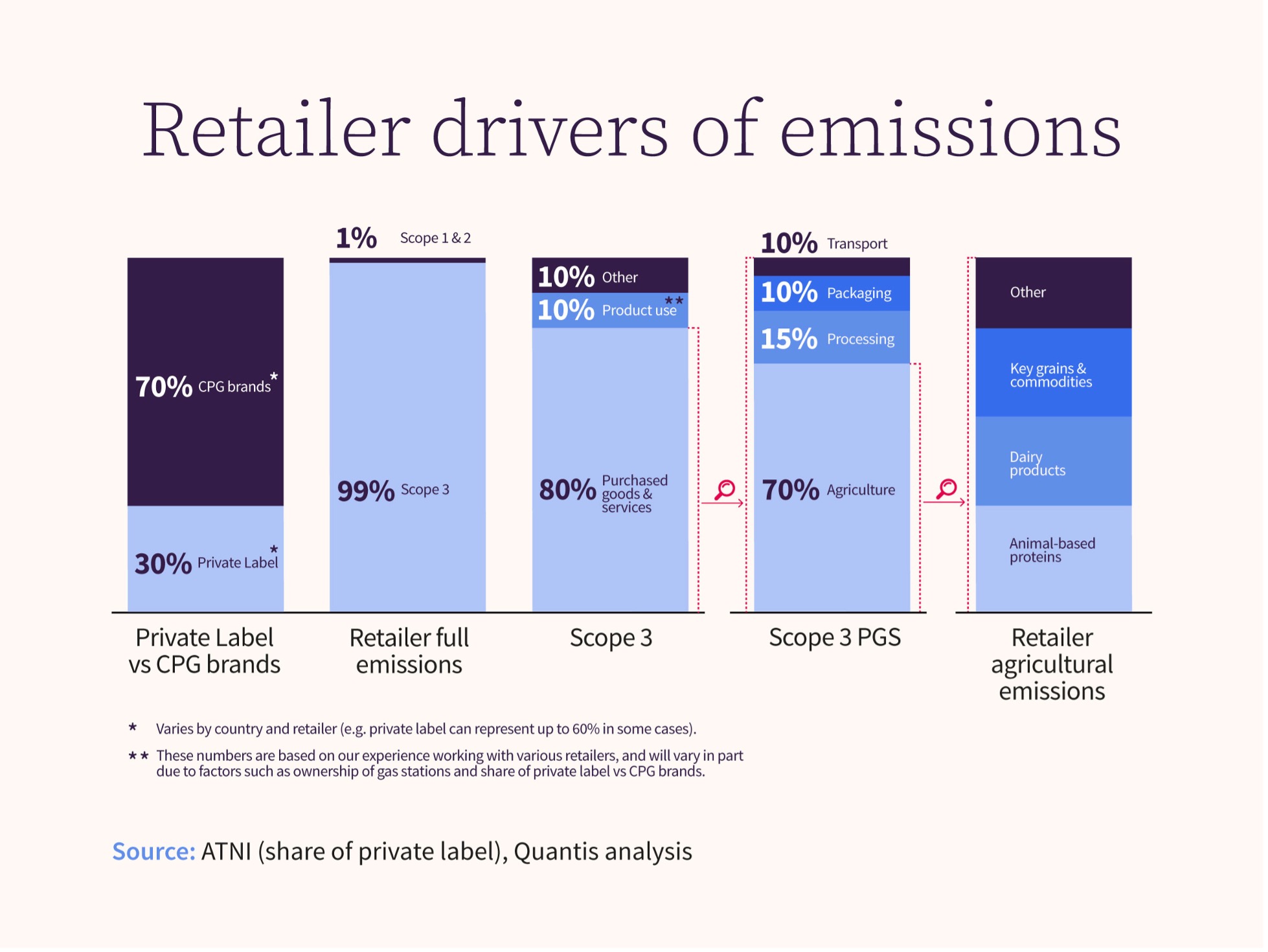
For most retailers, the bulk of environmental impact sits in scope 3 — tied not to stores or trucks, but to the thousands of products they buy and sell. Yet retailers have limited visibility into how those products are made. Outside of private label, they don’t own formulations, manage sourcing decisions or control upstream processes. That information sits with brands and manufacturers, often fragmented across suppliers, geographies and data systems.
As a result, retailers are increasingly expected to measure, report and reduce product-level impacts without consistent access to the data required to do so. Supplier-level targets or corporate commitments rarely translate cleanly into the footprint of individual products on the shelf, and improvements may occur in parts of a supplier’s business that have little relevance to specific SKUs. Measurement is therefore not just a technical challenge, but a structural one — rooted in the way responsibility and data are distributed across the value chain.
The opportunity for retailers:
Progress is being made as retailers strengthen their digital foundations and begin using AI in more targeted ways. When grounded in structured data, clear methodologies and strong governance, these tools help retailers move beyond static averages toward more usable insight — even where primary data remains incomplete.
Used responsibly, AI can support scale and consistency by helping teams handle large datasets, explore scenarios, and flag anomalies. Its role is supportive, not decisive: expertise and judgment remain essential to interpreting results and setting priorities.
This capability also improves how retailers work with suppliers. With clearer insight into hotspots and impact drivers, engagement can focus on the areas that matter most, with data requests sequenced more realistically. Over time, this supports better data quality through collaboration, rather than pressure alone.
Measurement technologies — including carbon management platforms — can further accelerate portfolio transformation by structuring how data is collected, shared and interpreted across the value chain. When implemented with clear methodologies and governance, these systems reduce friction in supplier data exchange, improve comparability across categories and enable more strategic engagement with priority suppliers. Rather than simply aggregating emissions data, they create a common reference point that supports targeted action — helping retailers connect measurement directly to sourcing decisions, supplier dialogue and portfolio evolution.
Used this way, measurement becomes less about reporting and more about managing impact — informing category decisions, supplier dialogue and portfolio choices in complex, data-constrained environments.
3. Portfolio rigidity
Retailers are deeply attuned to what sells. Years of data on category performance, consumer behavior and pricing thresholds make clear that significant shifts in high-volume categories such as dairy, meat or bakery carry commercial risk. Even where there is stated consumer interest in sustainability, purchasing behavior at checkout often tells a different story. The well-documented “say–do” gap persists: many shoppers express concern about environmental issues, far fewer consistently change what they buy or pay more for it.
Labeling can help — but only up to a point. When prices stay the same, clear and trusted labels can nudge behavior. Nutrition labeling offers a useful parallel. France’s Nutri-Score system, which rates products from A to E, has influenced purchasing patterns, with A and B-rated products gaining share while E-rated products often stall.
Applying that logic to environmental impact is more complex. While interest in carbon or eco-scores is growing, there is still no shared definition of what “good” looks like. Recent research suggests that, at constant price, products carrying credible environmental labels can outperform their conventional counterparts — indicating that environmental information does carry value for consumers.
However, without consistent standards across brands, categories and markets, those signals remain uneven. Unlike health, which offers a direct and personal benefit, climate and biodiversity claims can feel abstract, and trust is easily eroded when methodologies differ or lack transparency. As a result, portfolio change remains a careful balancing act: advancing sustainability in ways that are credible and comparable, without undermining trust, relevance or margin.
The opportunity for retailers:
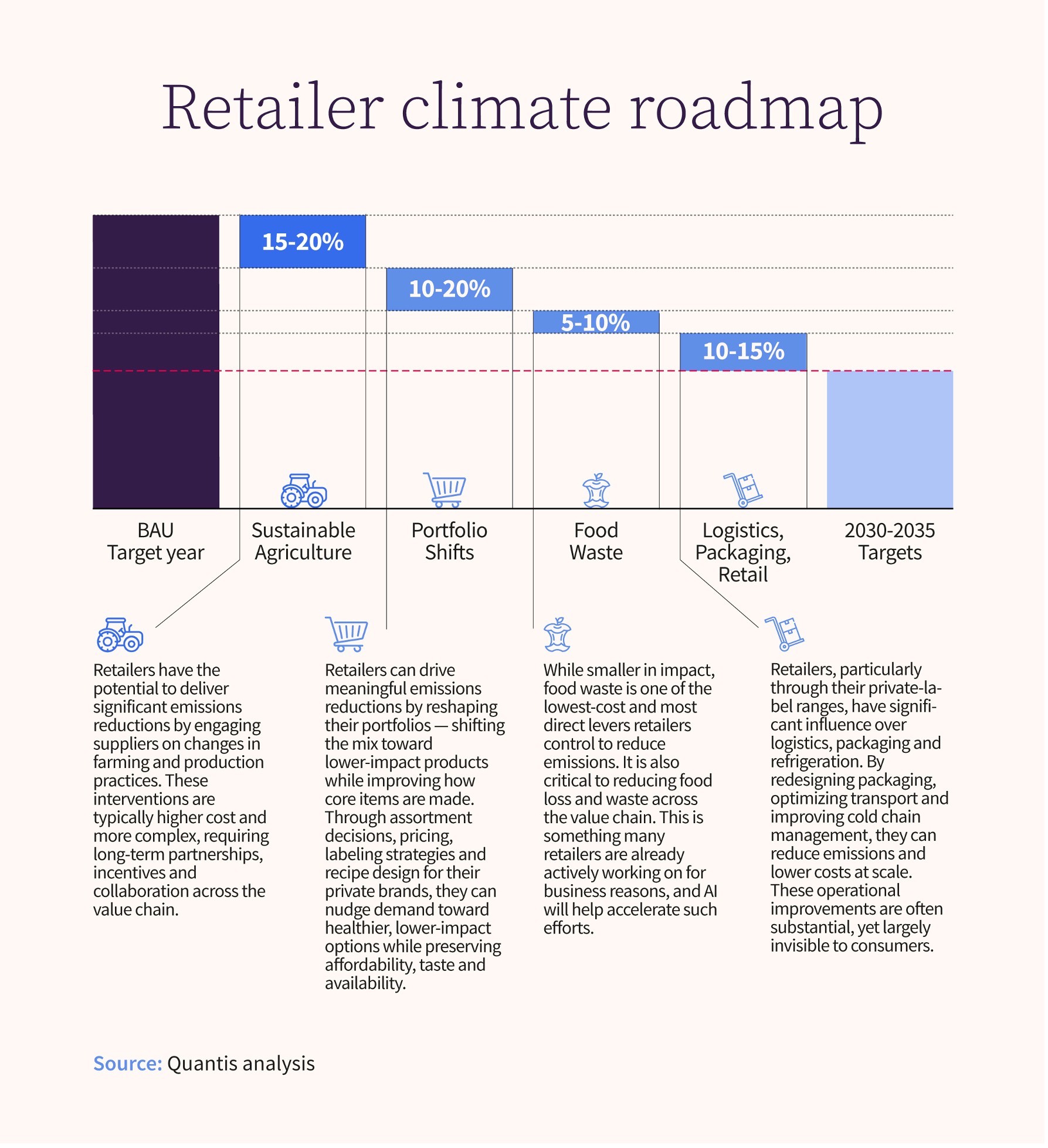
The opportunity lies in improving the impact performance of products that remain core to the basket. In high-volume categories where substitution is limited, progress depends less on changing what consumers buy and more on changing how those products are made.
This places supplier engagement at the center of portfolio evolution. By building longer-term, more durable partnerships with suppliers — and working together on sourcing practices, production methods or input choices — retailers can reduce the footprint of existing products while preserving price, taste and availability. These behind-the-scenes changes allow impact reduction to scale, while also helping manage supply constraints and price pressure in volatile categories.
“It is key that each manufacturer/brand invests in decarbonization, otherwise it will be marginalized in the long term…We will favour the most sustainable bidder i.e. develop their volumes. They will be able to count on our powerful Marketing/Promo tools, and others to come.”
Buyer, European retailer
Strategic priorities for retailers
For retailers, sustainability is no longer a parallel ambition. It is increasingly a source of strategic advantage — shaping how companies secure supply, manage costs and build long-term profitability. Across these priorities, better data, digital infrastructure and targeted use of AI play a supporting role — enabling retailers to act with greater consistency, speed and scale.
1. Risk assessment: understanding exposure before impact
For retailers, building resilience starts with understanding where they are exposed, not where emissions are highest. Risk assessment is first and foremost about dependency and traceability: knowing which products, regions and suppliers are critical to availability, cost and margin.
Only with that visibility can risk be assessed meaningfully.
In practice, this means:
- Improving traceability across priority categories to understand sourcing regions and supplier dependencies
- Identifying physical risks — such as heat stress, drought, flooding or water scarcity — that threaten production, yields or logistics in those regions
- Assessing transition risks, including regulatory change, evolving standards, market shifts and cost exposure linked to climate and nature policies
For retailers, the priority is not emissions reduction at this stage, but anticipation: knowing where climate and nature pressures threaten supply, price stability or availability.
2. Supply chain transformation: securing supply while reducing impact
Insight only creates value if it leads to action. For most retailers, that action sits upstream.
The largest impacts — and the greatest vulnerabilities — are concentrated in a relatively small number of high-volume categories and sourcing regions. Progress therefore depends on enabling change where scale and exposure are greatest, rather than spreading effort thinly.
This involves:
- Prioritizing suppliers and categories based on impact and risk
- Building longer-term partnerships that support changes in sourcing, production methods or inputs
- Aligning expectations, data and incentives so collaboration focuses on what will actually move the needle
- Tracking progress over time, focusing on real change in supply chains rather than methodological or scope adjustments, to understand what is improving, where progress is stalling and where further support is needed
At scale, supply chain transformation strengthens resilience by reducing exposure to volatility and disruption, while helping protect margins and keep core products affordable and available.
3. Green premiums: managing cost, value and credibility
Green premiums are emerging unevenly, and in many cases climate performance is becoming a baseline requirement rather than a bonus. For retailers operating within tight margins, the strategic question is not if green premiums exist, but where they are unavoidable, where they can be reduced or designed out altogether — and where consumers are willing to accept them in exchange for clear, credible value.
Addressing this requires precision:
- Distinguishing categories where climate performance is a license to operate from those where it still creates differentiation
- Requiring structured, verifiable offers from suppliers — including co-ops and raw material producers — so premiums reflect real performance, not ambition
- Embedding sustainability into sourcing and product economics, rather than relying on visible price uplifts at the shelf
In many cases, the most resilient approach is not to pass on a green premium, but to eliminate it through scale, collaboration and efficiency. Where premiums persist, credibility is what determines whether they undermine margins and trust or support long-term competitiveness as low carbon supply chains become standard.
Looking ahead
“Set a direction your teams and consumers can rally behind. A few decisive actions — done well and communicated clearly — can shift an entire portfolio.”
Allon Zeitoun, Global Leader + Managing Director, Quantis
Sustainability won’t reshape retail overnight. But every practical step — improving sourcing, design or collaboration — moves the sector in the right direction. As data, collaboration and regulation converge, those that act deliberately today can turn constraint into competitive advantage and profitability — shaping not only what people buy, but how value is created across the entire supply chain.