
In brief:
- Innovation success is determined early. Scouting, screening and evaluation shape what scales.
- Sustainability informs decisions from the start. It helps teams account for risk, constraints and long-term viability.
- Align the pipeline first. Focus innovation on priority impact areas and key risks.
- Apply clear screening criteria. Filter ideas based on impact, risk and scalability.
- Measure performance to manage trade-offs. Compare innovations to support better decisions.
- Translate insight into action. Clear ownership and thresholds enable adoption at scale.
- A structured pipeline drives value. It improves decisions, reduces risk and increases success rates.
Innovation is rarely the result of a single breakthrough. It develops over time, as ideas are tested, strengthened, and brought to scale. When they take hold, those ideas change how people live, how businesses operate, and how value is delivered across industries, redefining competitive dynamics and raising expectations across markets.
The innovations that succeed over time tend to share one thing in common: they anticipate the forces shaping tomorrow’s business landscape. Resource availability, regulation, supply volatility, and shifting customer demands increasingly determine whether new ideas scale successfully or struggle to move beyond pilot.
Today, sustainability plays a central role in building business resilience, shaping innovation decisions that account for risk, impact, and long-term viability. For innovation teams, this marks a shift. Sustainability has become a strategic input into the earliest decisions, helping companies focus their efforts on innovations that scale and shape the footprint and risk profile of the business over time.
Where innovation decisions matter most
Innovation shapes future portfolios through a sequence of structured decisions, many of which are made well before products reach the market.
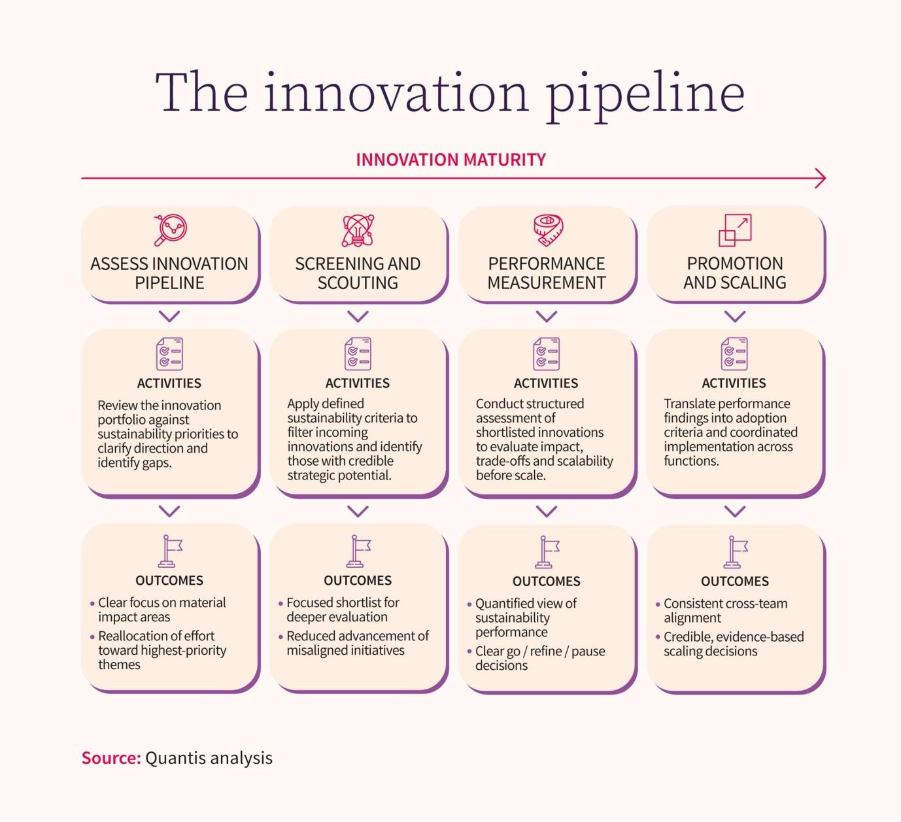
For companies, this process typically includes four stages:
- Assessing the current pipeline — reviewing existing portfolios to determine whether they respond to priority consumer needs, operational constraints and material sustainability challenges.
- Screening and scouting — identifying which technologies appear promising at a high level, are strategically aligned and warrant further investigation and shortlisting.
- Performance measurement — evaluating environmental and operational implications of shortlisted innovations in greater detail.
- Promotion and scaling — aligning teams and partners to translate potential innovations into implementation, while building the operational capabilities, expertise and processes required to scale.
Although interconnected, these stages do not carry equal influence. The greatest risks and opportunities in innovation sit in the early phases — particularly during scouting, shortlisting and evaluation. These decisions determine which ideas receive funding, attention and internal backing, shaping direction long before products reach the market.
This is also where sustainable innovation has the most leverage. Choices made at this point influence not only environmental impact, but long-term resilience. They shape exposure to regulatory shifts, sourcing constraints, reputational risk, and future operating costs. Embedding sustainability early allows companies to anticipate these pressures rather than react to them later.
Early evaluation creates the opportunity to look beyond technical feasibility and consider circularity potential, sourcing traceability, biodiversity and social dimensions, regulatory outlook, and future market conditions. Examining these factors together allows teams to identify solutions that are not only viable today but positioned to perform as expectations and constraints evolve. In open innovation, where external solutions are assessed under dynamic conditions, this broader perspective becomes a source of resilience and competitive advantage.
At the same time, these judgments are made with limited and evolving information. Environmental data are often sparse, technologies still developing, and performance claims not yet fully validated. Traditional life cycle assessments, designed for mature systems, rarely provide sufficient guidance at this stage.
The following steps take a closer look at how sustainability informs each stage in practice, beginning with assessing the innovation pipeline itself.
1. Assessing the innovation pipeline: Set direction before scouting begins
Before exploring new solutions, companies need clarity on what their existing innovation efforts are intended to achieve.
At this stage, the focus is directional rather than technical. The objective is to determine whether innovation effort is concentrated on the most material impact areas and long-term risks, not simply on areas of market visibility or short-term growth.
Over time, innovation portfolios expand through pilots, partnerships, internal initiatives and emerging ideas. What begins as targeted exploration can evolve into a broad set of activities that are active, but not always aligned with the environmental, regulatory and operational realities the business will need to navigate.
Key questions include:
- Which material environmental challenges are currently being addressed through innovation?
- Where is effort concentrated?
- Where are gaps relative to sustainability targets and long-term objectives?
- Are resources aligned with the company’s most material risks and opportunities?
In practice: Aligning innovation portfolios
In one FMCG company, sustainability targets and the broader strategic plan were used as the reference point for reviewing the innovation portfolio. Innovation themes were assessed across geographies and product categories, and competitor activity was benchmarked to understand where effort was concentrated and where gaps remained. This portfolio-level view clarified where innovation required reinforcement before new solutions were pursued.
In another food and beverage company, assessment took the form of three cross-functional workshops involving 30 experts. The teams focused on reducing the environmental footprint of specific recipes, which were then used as benchmarks to guide thinking across ingredients and product categories. The exercise generated more than 40 ideas, providing clarity on where innovation could most meaningfully reduce impact before feasibility and potential were evaluated.
How sustainability shapes decisions
Sustainability sets the basis for portfolio-level decision-making. Instead of reviewing innovation themes primarily on growth potential or market visibility, teams evaluate whether resources are concentrated on the most material impact areas and long-term risks.
Embedding this perspective early enables organizations to redirect effort before new technologies are pursued, strengthening the foundation for subsequent screening and shortlisting. It can also surface new opportunities by introducing clear constraints that challenge teams to think outside the box.
In practice, this means reviewing the portfolio as a whole. It involves mapping current initiatives against environmental hotspots and strategic priorities to understand whether innovation effort reflects what matters most.
| Practical Actions | Intended Outcomes |
| Review entire innovation portfolio against defined sustainability targets, material impact areas, risks and dependencies | Alignment with strategic priorities and de-risking |
| Map initiatives to identify gaps, overlaps and under-addressed impact areas | Better allocation of innovation resources |
| Benchmark competitor innovation themes where relevant | Identification of opportunity areas |
| Establish explicit sustainability reference points (e.g., priority impact areas, quantified targets) | Defined directional focus before new exploration |
2. Screening and scouting: Focus on what matters
With portfolio direction established, attention turns to the innovations entering the pipeline.
Scouting often begins broadly — through accelerators, industry networks, inbound proposals or technology scans. This openness is valuable, but without structured criteria exploration can become reactive. Ideas gain traction because they are visible or well-positioned, rather than because they address defined sustainability priorities.
At this stage, innovations are reviewed against consistent environmental and strategic criteria to determine whether they merit deeper evaluation. Screening focuses on testing relevance to priority impact areas, exposure to sourcing or regulatory constraints, and credible potential to scale within the value chain, without requiring full impact assessments.
The result is a focused shortlist: a smaller set of innovations that justify more detailed performance measurement.
In practice: Screening innovation pipelines
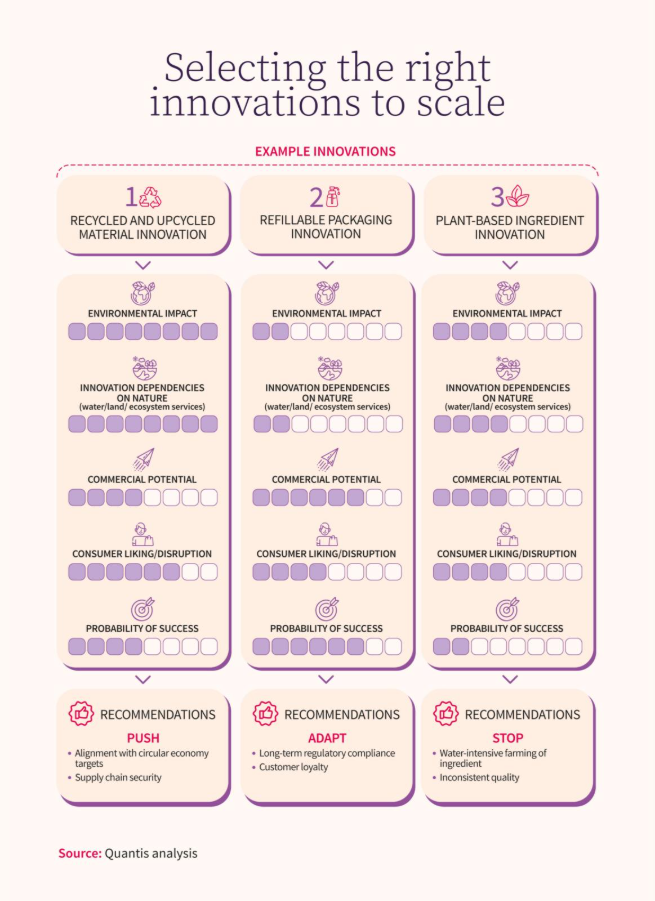
In one luxury-sector innovation program, technologies were screened individually against defined sustainability and business criteria across four key dimensions — carbon, biodiversity, circularity and traceability — with each innovation assessed against approximately 12 criteria before advancing. This structured filter ensured that alignment with priority impact areas, associated risks, and value-chain realities and gaps was clearly assessed before entering the next stage of potential co-development.
How sustainability shapes decisions
Instead of progressing ideas based on novelty or market momentum alone, teams should assess whether a solution addresses priority impact areas, avoids foreseeable regulatory or sourcing constraints, and demonstrates plausible scalability in a context of growing resource scarcity and competition.
By introducing these considerations at the outset, sustainability changes how technologies are selected to advance. Decisions are based on relevance to priority impact areas, not interest-driven exploration. This requires setting clear screening thresholds in advance so that incoming innovations are evaluated systematically and consistently.
| Practical Actions | Intended Outcomes |
| Define clear screening criteria aligned with sustainability targets, minimizing risks and impacts | Consistent first-level filtering of incoming ideas |
| Apply high-level environmental due diligence (impact relevance, regulatory exposure, scalability) | Shortlist of innovations worthy of deeper evaluation |
| Compare innovations against conventional solutions to assess potential improvement | Avoid advancement of marginal or misaligned solutions |
| Document rationale for advancing or pausing technologies | Transparent and repeatable screening decisions |
3. Performance measurement: Manage trade-offs before scale
Once a focused shortlist has been established, assessment moves into structured performance measurement.
At this stage, innovations undergo detailed environmental due diligence. Teams assess environmental impacts — including carbon, biodiversity and nature — alongside circularity potential and traceability, as well as social risk signals. Additionally, they evaluate feasibility factors such as scalability risks, technology readiness, and exposure to climate-related, regulatory, and reputational risks. Performance is then evaluated relative to conventional solutions to determine whether meaningful improvement is likely.
Life cycle assessment remains an important tool, but early-stage innovations rarely provide stable data for definitive conclusions. Assumptions must be transparent and uncertainty acknowledged; the objective is informed comparison, not absolute precision.
Trade-offs become visible. An innovation may reduce carbon intensity while increasing pressure on water or biodiversity, or demonstrate strong performance while facing sourcing or regulatory constraints. Structured measurement surfaces these tensions before scale amplifies them.
In practice: Evaluating environmental performance
In one case, a textile material innovator undertook comparative environmental assessment prior to expanding production. Early analysis identified environmental advantages alongside areas requiring refinement. Transparent documentation of assumptions supported process adjustments and strengthened discussions with brand partners before further investment.
How sustainability shapes decisions
By grounding decisions in measured performance and clearly identified trade-offs, sustainability strengthens investment discipline and supports more deliberate capital allocation.
At this stage, organizations should formalize a stage-gate decision supported by structured scoring across impact dimensions, ensuring trade-offs are documented before scale is approved. In practice, this level of consistency is enabled by digital systems that allow performance data to be captured, compared and shared across teams.
| Practical Actions | Intended Outcomes |
| Conduct structured environmental due diligence (carbon, biodiversity, water, circularity, traceability, risk exposure) | Quantified understanding of sustainability performance |
| Use comparative scoring frameworks across impact dimensions | Consistent evaluation across shortlisted innovations |
| Document assumptions and data gaps explicitly | Transparent trade-off management |
| Formalize stage-gate decision supported by scoring results | Clear go / refine / pause decisions before scale |
4. Promotion and scaling: Turn innovation into adoption
After performance measurement, the question shifts from evaluation to implementation.
Environmental findings should not remain in reports. They inform improvement plans developed with innovators and clarify the conditions for adoption. Yet for innovation to scale, technical validation alone is insufficient. Internal alignment, and often credible external positioning, are essential. Measurement becomes a foundation not just for refinement, but for adoption.
In practice: Scaling innovation across teams
In one major fashion innovation program, structured environmental assessment extended into scaling. LCA results informed improvement plans and were translated into clear internal guidance, allowing corporate and brand teams to work from shared performance criteria before rollout.
Scaling requires defined ownership and explicit adoption thresholds across innovation, sustainability, procurement and marketing teams. When expectations are clear and grounded in evidence, implementation becomes coordinated and repeatable.
How sustainability shapes decisions
At this stage, sustainability connects analysis to action. It provides the evidence base for improvement plans, adoption decisions and communication guidance, ensuring that scaled innovations are consistent with environmental commitments and operational realities.
When supported by shared digital systems, this evidence becomes accessible across teams, enabling consistent interpretation of performance data and alignment in decision-making. As a result, scaling becomes more coordinated and repeatable across functions and markets, reinforcing alignment across the value chain.
| Practical Actions | Intended Outcomes |
| Assign a named cross-functional owner and taskforce (Innovation, Sustainability, Procurement) for each shortlisted innovation | Clear accountability for scaling decisions |
| Translate performance results into clear go / no-go thresholds for procurement and product teams | Consistent adoption criteria across functions |
| Create an internal adoption brief summarizing performance, trade-offs and approved sustainability claims | Aligned internal decision-making |
| Develop a documented improvement roadmap with the innovator based on LCA and measurement findings | Reduced late-stage friction |
| Integrate sustainability criteria into supplier contracts and technical specifications | Scalable integration into sourcing and operations |
| Align legal, marketing and sustainability teams on substantiated external communication before launch | Credible, evidence-based sustainability claims |
Building innovation that holds up
Innovation shapes the capabilities a company carries into the future. The decisions made during assessment, scouting and screening, performance measurement and promotion determine whether new solutions are aligned with the realities of today and tomorrow and ensure that investment is directed toward solutions with credible potential to scale.
An organized and targeted innovation pipeline is essential for focusing resources, reducing risk and improving the success rate of innovations brought to market. Across industries, we see leading innovators applying structured frameworks like this to bring greater discipline to how ideas are selected, evaluated and prioritized.
Sustainable product innovation is not an additional layer of review. It is a way of structuring innovation itself. It connects environmental insight to strategy, aligns teams around shared criteria and translates ambition into disciplined action. Done well, it creates business value by improving decision quality, reducing risk and enabling companies to prioritize innovations that deliver measurable results as market and operating conditions evolve.