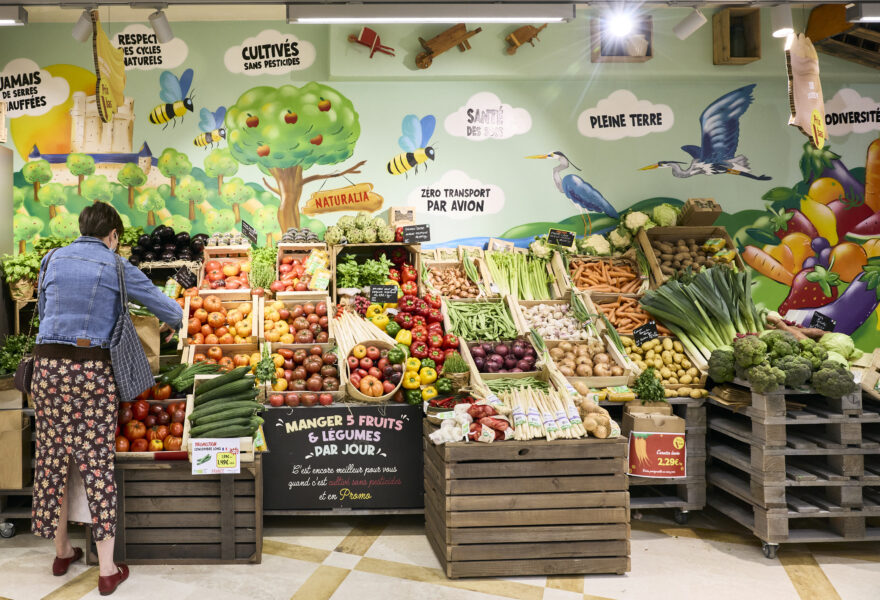
Naturalia, Casino Group’s organic retail brand, is taking a new step forward in its environmental commitment by launching, in partnership with Quantis, a groundbreaking initiative aimed at strengthening the resilience of its agricultural supply chains. The project focused primarily on two complementary areas: mapping the impacts of and dependencies on ecosystem services across the entire food procurement portfolio to identify the most vulnerable supply chains; and conducting a detailed analysis of physical risks and their financial implications across two pilot supply chains (tomatoes and almonds), culminating in a three-year resilience action plan developed in collaboration with internal teams.

Challenge
In a context where food supply chains are exposed to growing risks, retailers must anticipate disruptions. Since 2020, the volatility of agricultural yields and commodity prices has reached unprecedented levels, undermining the supply chains of food retailers. The standard organic system is already one step ahead, offering significant environmental benefits (e.g., water quality, soil health, etc.), but remains vulnerable to the acceleration of climate change. In this context, the pressure is twofold: meeting consumers’ environmental expectations while coping with increasingly vulnerable agricultural ecosystems.
The CSRD and the EUDR11 underscore this urgency by requiring a formal assessment of natural risks that goes far beyond carbon alone.
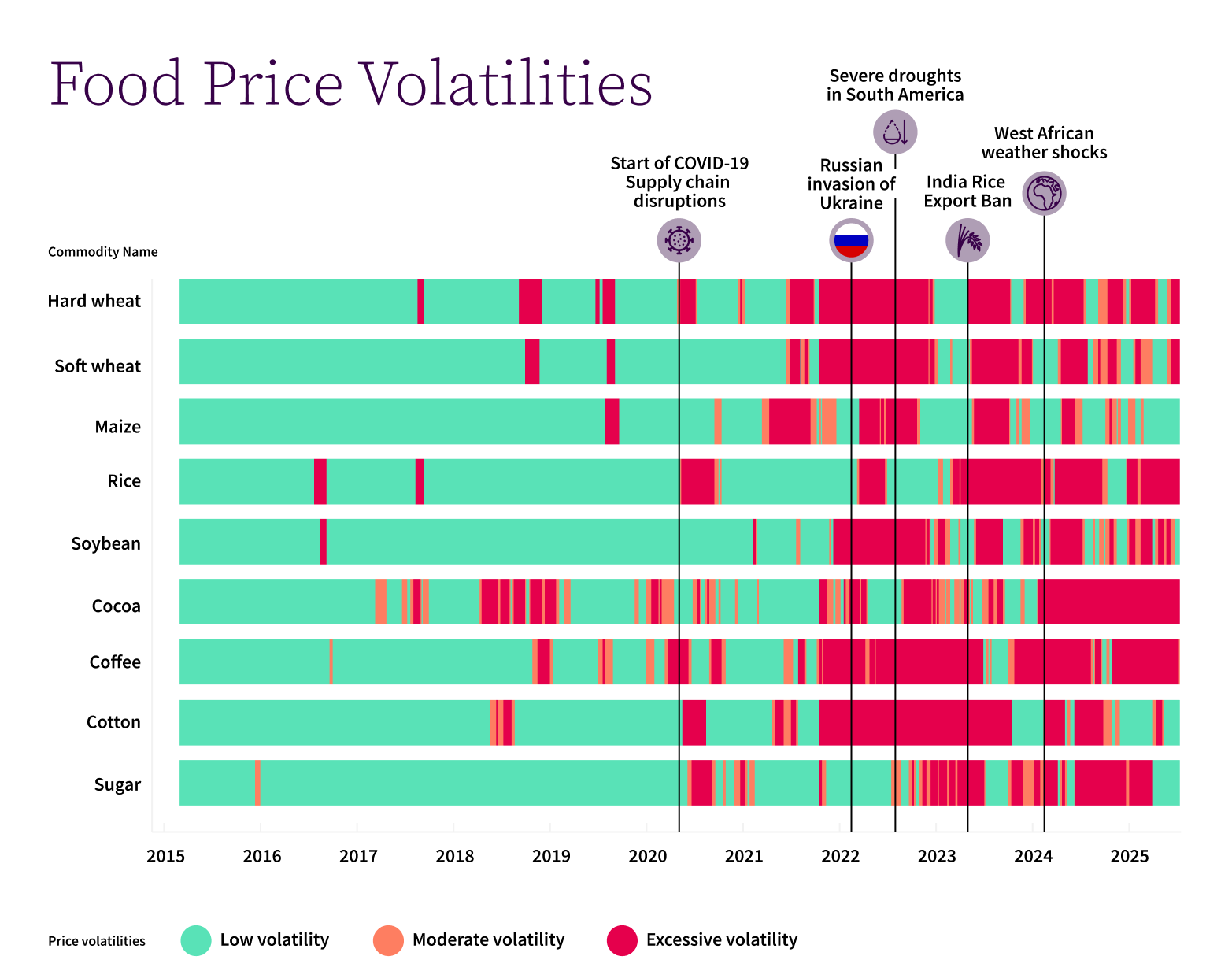
This graph shows periods of excessive price variability as defined by IFPRI (High volatility occurs when the frequency of extreme prices increases (prices >5%), while average volatility corresponds to prices that exceed average fluctuations (probability 2.5–5%). This graph covers the entire sector, not just the organic sector.
Source: IFPRI Food Security Portal
Naturalia turned to Quantis with a clear objective: to move from intuition to concrete evidence. The retailer needed to objectively identify the supply chains most exposed to natural and climate risks, understand its suppliers’ agricultural practices beyond its own organic specifications, and quantify the associated financial stakes. By engaging its procurement teams and supplier partners, the retailer is moving from analyzing nature-related risks to making concrete changes to its supply chains.
Solution: a collaborative approach developed together with the teams and suppliers
Beyond the analysis, Naturalia turned this project into a collective effort.
The procurement teams were directly involved in identifying risks and areas for action, while suppliers were asked to share their practices and constraints. Quantis developed a structured methodology with a three-step approach: prioritizing the most exposed supply chains, conducting a detailed assessment of their physical and financial risks, and then co-developing a concrete action plan with internal teams.
1. Prioritizing High-Stakes Sectors
Quantis conducted a macroeconomic analysis of the impacts on and dependencies regarding ecosystem services2 across Naturalia’s entire food procurement portfolio, using the ENCORE3 database. Impacts refer to the effects Naturalia’s operations have on ecosystems, while dependencies refer to what Naturalia draws from ecosystems to function. The scores were adjusted to account for the specific characteristics of organic farming compared to conventional practices. This approach made it possibleto identify the top 10 priority supply chains, two of which were selected for an in-depth pilot study: tomatoes and almonds.
2. Risk Analysis of the Tomato and Almond Sectors
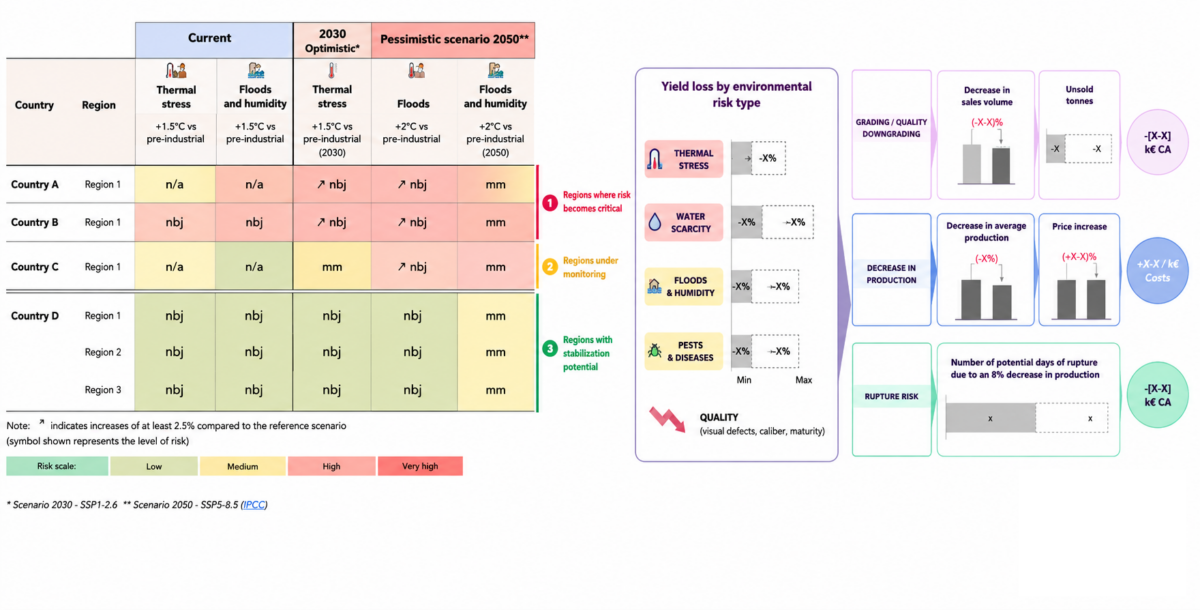
For these two pilot sectors, Quantis quantified current and future physical environmental risks to nature and the climate ( water stress, drought, pollinator decline, soil erosion, heat stress) in the supply areas in France, Spain, and Italy, using two IPCC scenarios and three time horizons (present, 2030, 2050). These risks were translated into operational and financial impacts based on interviews and questionnaires conducted directly with procurement teams and suppliers.
For the almond sector, the analysis reveals that growing regions in Spain and Italy are already highly vulnerable to water stress, drought, and pollinator decline, with conditions expected to worsen by 2050, resulting in volume losses, declines in quality, and a significant increase in purchase costs.
3. Resilience Roadmap
Based on these results, cross-functional workshops were held with Naturalia’s teams (procurement, marketing, quality, strategy) to collaboratively develop a prioritized three-year resilience action plan. The areas addressed include supporting the agricultural transition (including procurement policies), adapting the product offering, diversifying supply chains, and mobilizing the partner ecosystem. This action plan was distilled into three concrete and actionable priorities for 2026.
Climate change and biodiversity loss are no longer just theoretical risks: they are already affecting our supply chains and food supplies. Our goal is clear: to turn these challenges into opportunities to build more resilient supply chains, working alongside our producers.
Richard Jolivet, Chief Executive Officer, Naturalia
Results
This participatory approach helps embed the transition at the heart of operational decisions and develop solutions tailored to on-the-ground realities. With this initiative, Naturalia ranks among the first organic retailers to systematically integrate biodiversity risks into its sourcing strategy. Key point: All findings were linked to Naturalia’s specific business context, constraints, and market dynamics, making them immediately actionable for purchasing decisions and strategic planning.
- Quantitative and qualitative data that can be directly used for CSRD reporting under ESRS E2 (Pollution), E3 (Water and Marine Resources), and E4 (Biodiversity and Ecosystems)
- A prioritized list of sectors in which to deepen knowledge and take targeted action
- A clear and financially substantiated assessment of Naturalia’s exposure to natural and climate-related risks in the tomato and almond sectors, along with the available adaptation measures
- A pragmatic resilience roadmap developed collaboratively over three years, with concrete actions scheduled through the end of 2026
- An initial effort to raise buyers’ awareness of environmental and agronomic issues, achieved through direct dialogue with suppliers and active involvement in the analysis
This approach paves the way for a gradual shift in procurement practices and specifications, with the aim of helping producers adapt to climate and biodiversity challenges.
As an organic retailer, we have a special responsibility toward the environment and our customers. Our collaboration with Quantis has given us the tools to translate this commitment into concrete actions grounded in the agronomic and economic realities of our supply chain.
Sidonie Tagliante, Director of Marketing, Communications, and CSR, Naturalia
- European Regulation on Deforestation ↩︎
- Ecosystem services are defined as “the benefits provided by nature, living species, and ecosystems to human populations” (source: Foundation for Biodiversity Research). For example: access to water, pollination, soil fertility, climate regulation, etc. ↩︎
- The ENCORE database is recommended by the Task Force on Nature-related Financial Disclosures (TNFD) and the Science-Based Targets Network (SBTN). ↩︎
Ready to align sustainability with business performance?