
In brief:
- As awareness of the healthcare sector’s environmental footprint grows (accounting for more than 5% of global greenhouse gas emissions), public authorities across the EU and beyond are increasingly mandating environmental disclosure in healthcare procurement.
- Some pharma companies are preparing, investing not only in improving their environmental performance but also in applying an ecodesign lens to their products through product carbon footprints (PCFs) and life cycle assessments (LCAs). Most are not yet able to provide accurate, comprehensive environmental data at the pace, quality and scale some health systems require.
- The industry has begun to organize through PAS 2090, the first global sector standard for pharmaceutical PCF and LCA.
- Closing the readiness gap requires four actions: define the purpose PCF/LCA must serve, build data infrastructure early, pilot before scaling, and embed LCA insights into ecodesign and product decisions.
- The companies best placed to compete are those that treat product sustainability as a strategic asset, not a compliance exercise.
For pharmaceutical manufacturers, a new set of criteria for market access is emerging: sustainability information. Healthcare systems account for more than 5% of global greenhouse gas emissions, and public authorities in many markets are drawing a direct line between the industry’s environmental footprint and procurement decisions. In the most advanced markets such as France and the UK, environmental criteria are shifting from optional differentiation to eligibility conditions and weighted award criteria, with buyer expectations moving progressively from corporate decarbonization plans to product-level emissions data. Pharmaceutical companies are responding to these requests, and leaders are already going further, using product-level environmental data not just to meet tender requirements but to drive ecodesign decisions that reduce cost and improve competitiveness.
As an example, an analysis of a sample of EU tenders (n=260) shows that sustainability requirements grew from roughly 23% in 2021 to over 40% in 2023, and are projected to continue, reinforcing that these requirements are structural rather than episodic.
What are PCF + LCA?
PCF (product carbon footprint): quantifies the greenhouse gas emissions of a product across its lifecycle
LCA (life cycle assessment): takes a broader approach, covering a wider range of environmental impacts on top of GHG including water use, ecotoxicity, and resource depletion
A PCF is a specific application of LCA methodology, focused on climate impact. Companies often begin with PCFs and expand to full LCAs as their measurement capability develops.
Where requirements are most advanced: product level footprints
Where public healthcare procurement is most regulated, sustainability requirements in tenders are evolving toward product-specific evidence (e.g., carbon footprint, lifecycle data), increasing granularity and complexity for suppliers. As an example, around the globe, suppliers are requested to answer to CDP supply chain questionnaires, while in the United Kingdom, suppliers are already required to publish company carbon reduction plans. Additionally, the NHS is planning to require product carbon footprints (PCFs) for all purchased products by 2028.
Prefer to explore rather than scroll?
In France, the score carbone médicament, a scoring methodology initially targeting 18 priority generic molecules, becomes a mandatory hospital tender criterion from August 2026. It is the most explicit example yet of a system moving from disclosure to active scoring, one where environmental performance plays a role in purchasing decisions, not just who can demonstrate compliance. This is especially applicable for the most standard products proposed by several manufacturers. Public tender requirements are now beginning to ripple upstream through the value chain, with suppliers and manufacturers increasingly embedding sustainability criteria into their own supplier assessments, for example.
In a recent study, Quantis identified demands for sustainability information in several other markets such as Germany, Spain, Belgium, Denmark and Brazil. In the US, the State of California passed legislation making Scope 1 and 2 emissions and climate risk disclosures mandatory for companies with revenues above US$1b, a requirement that applies equally to pharma companies in scope.
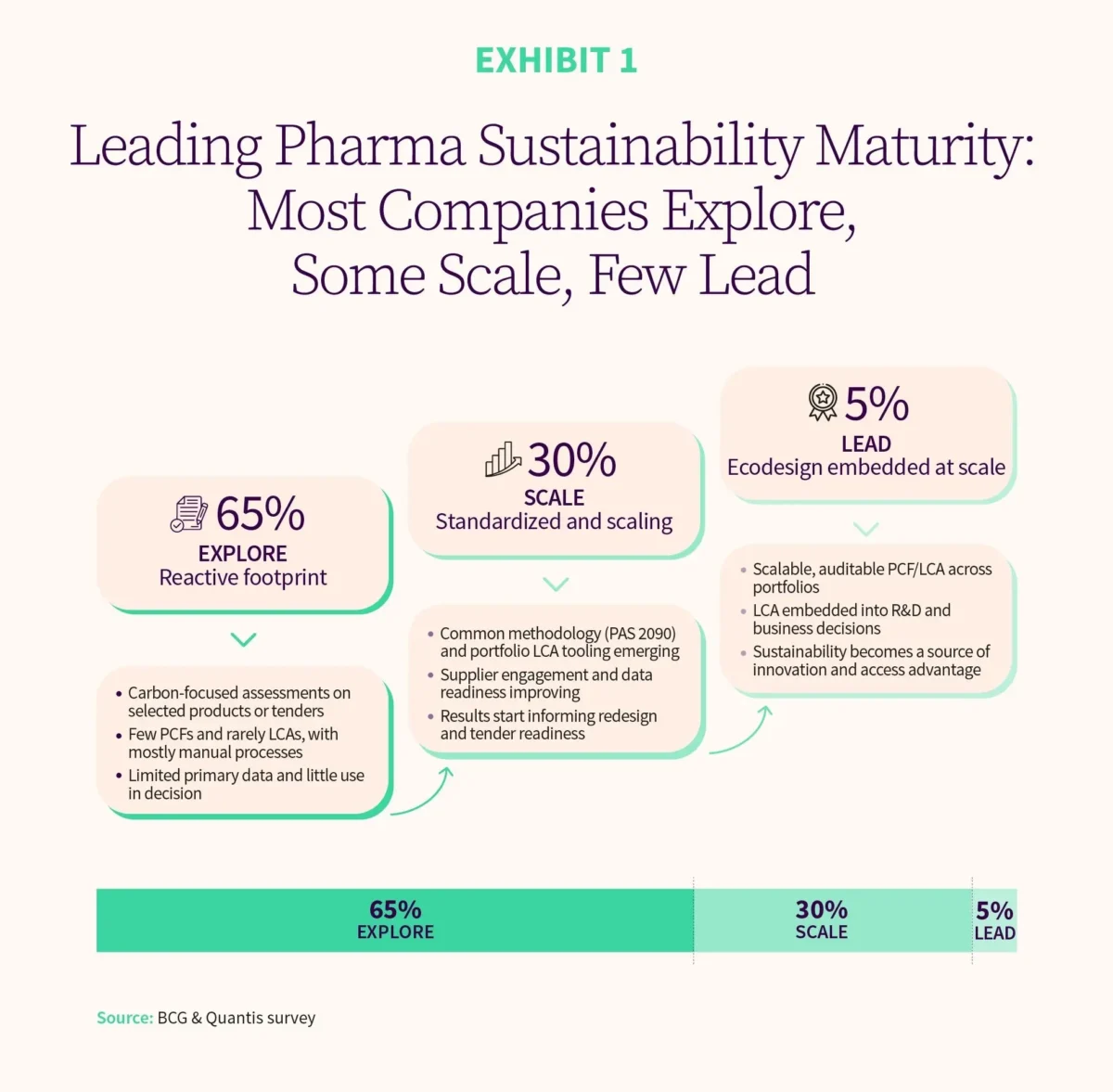
Players in these markets are starting to respond to these emerging requests. A recent benchmarking study performed on 13 pharma players by BCG and Quantis shows that most companies have started to track sustainability of products. Additionally, a survey of 26 pharma companies shows that about two-thirds have limited their efforts to a few products, relying on manual processes and concentrating mainly on carbon. Another third have started to standardize, measure at scale, and connect with suppliers to get more accurate data, with only a handful of leaders having reached the stage of embedding ecodesign across their product portfolio. (See Exhibit 1)
The industry has begun to address this collectively through PAS 2090, the first global sector standard for pharmaceutical PCF/LCA. (See: Standardization with PAS 2090)
Closing the operational readiness gap, and doing so before public procurement timelines make it urgent, requires four actions: define the purpose LCA must serve, build data infrastructure early, pilot before scaling, and embed LCA outputs into decision-making.
1. Define the purpose LCA must serve
LCA and PCF measurement is increasingly a tender requirement, but it is also a source of business value that leading companies are beginning to leverage through ecodesign. Using product-level environmental data to drive ecodesign decisions reduces material intensity, cuts costs, and improves process efficiency. These are financial benefits that help strengthen the business case for PCF/LCA at scale on top of market access.
The starting point is therefore clarity on what the LCA capability delivers: verified product-level data for tender readiness on one side, and actionable insights for ecodesign and portfolio decisions on the other. Infrastructure built around both from the outset generates returns on each. Companies in markets where sustainability criteria are beginning to be weighted in tender decisions are increasingly finding that this dual framing shapes both their tender readiness and their broader competitiveness.
2. Build the data infrastructure early
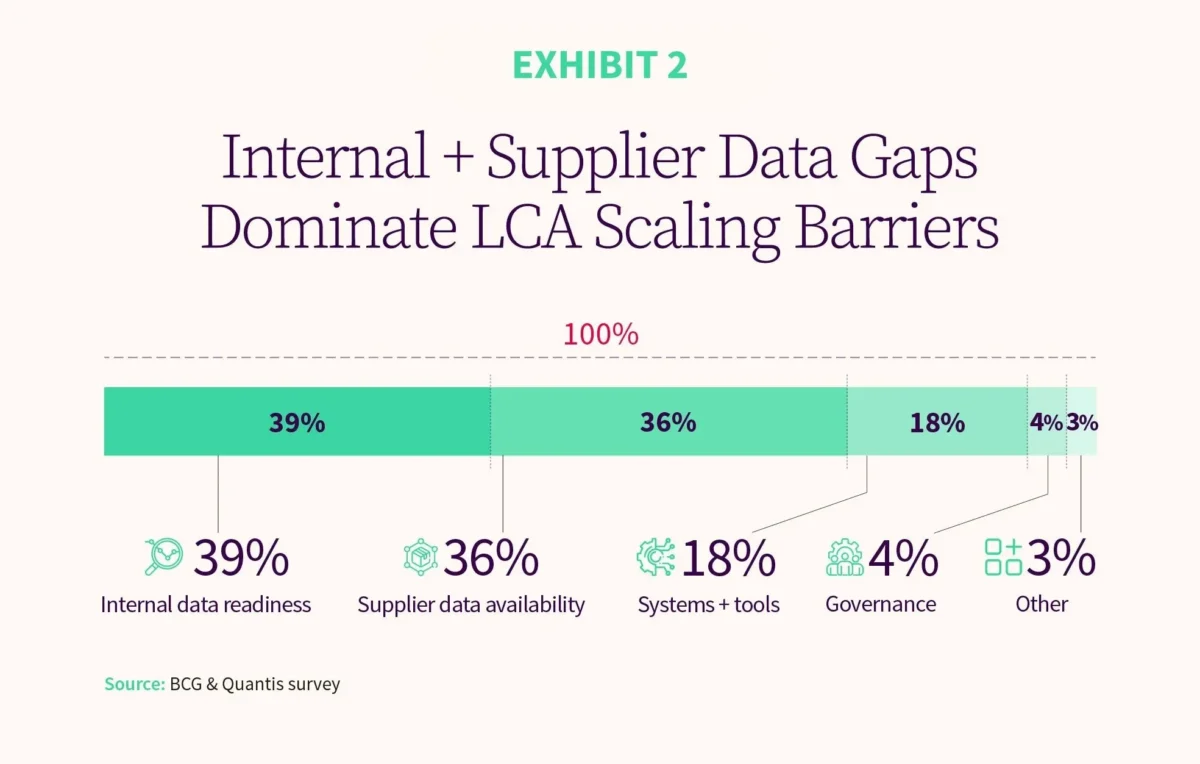
Scaling LCA across a portfolio is mainly a data and operating model challenge. Internal data readiness and supplier data availability are the two dominant constraints (see Exhibit 2), pointing to a systemic gap in data infrastructure across the value chain.
Internal product and process data is frequently incomplete or siloed across portfolios, manufacturing sites, and suppliers, and can be difficult to collect and to harmonize, especially for Active Pharmaceutical Ingredients (APIs). Supplier-specific emission factors are among the most consequential inputs to a product-level LCA and among the least developed. The challenge is compounded by the industry’s growing reliance on outsourced API manufacturing, which extends the data gap further up a supply chain that is already difficult to measure. The best practice is to integrate ecodesign from the early stages of product development, all the way from R&D, where decisions on formulations, delivery mechanisms, packaging formats, manufacturing processes, and sourcing options largely determine a product’s environmental profile throughout its commercial life. Integrating environmental considerations at this stage makes companies better prepared: when improvement opportunities are identified early, they are often easier and less costly to address than when they are raised later in response to external requests or tender requirements.
Companies that connect environmental data across digital systems and establish clear validation workflows aligned are better prepared to do so. Data is easier to collect, assumptions are more consistent, and product-level evidence is more credible and easier to mobilize when needed. The most advanced companies are already treating this as a forward-looking investment, building the capability ahead of formal requirements rather than in response to them. (See: Regulation and ecodesign: where LCA creates operational value) (See Exhibit 2)
3. Pilot before scaling
Deploying LCA as a scaled up, repeatable capability across a portfolio surfaces operational challenges that assessment programs rarely anticipate, including data ownership across commercial, R&D, and sustainability functions; supplier input validation protocols; consistent methodology application across product types with different manufacturing processes; output formatting for different procurement systems. These challenges require pragmatic answers that only come from running the process on real products under real conditions.
A structured pilot built around the products most exposed to sustainability criteria weighting in procurement generates those answers in a controlled environment. It validates methodology, stress-tests data infrastructure, and surfaces governance gaps before they become costly to fix. As an example, products facing French or UK criteria first might be the natural starting point, making the pilot immediately commercially relevant rather than a purely technical exercise.
4. Embed LCA insights into ecodesign and product decisions
After market access, where LCA investment creates the most business value is ecodesign: applying insights systematically to product and process design to act on the hotspots the assessment identifies.
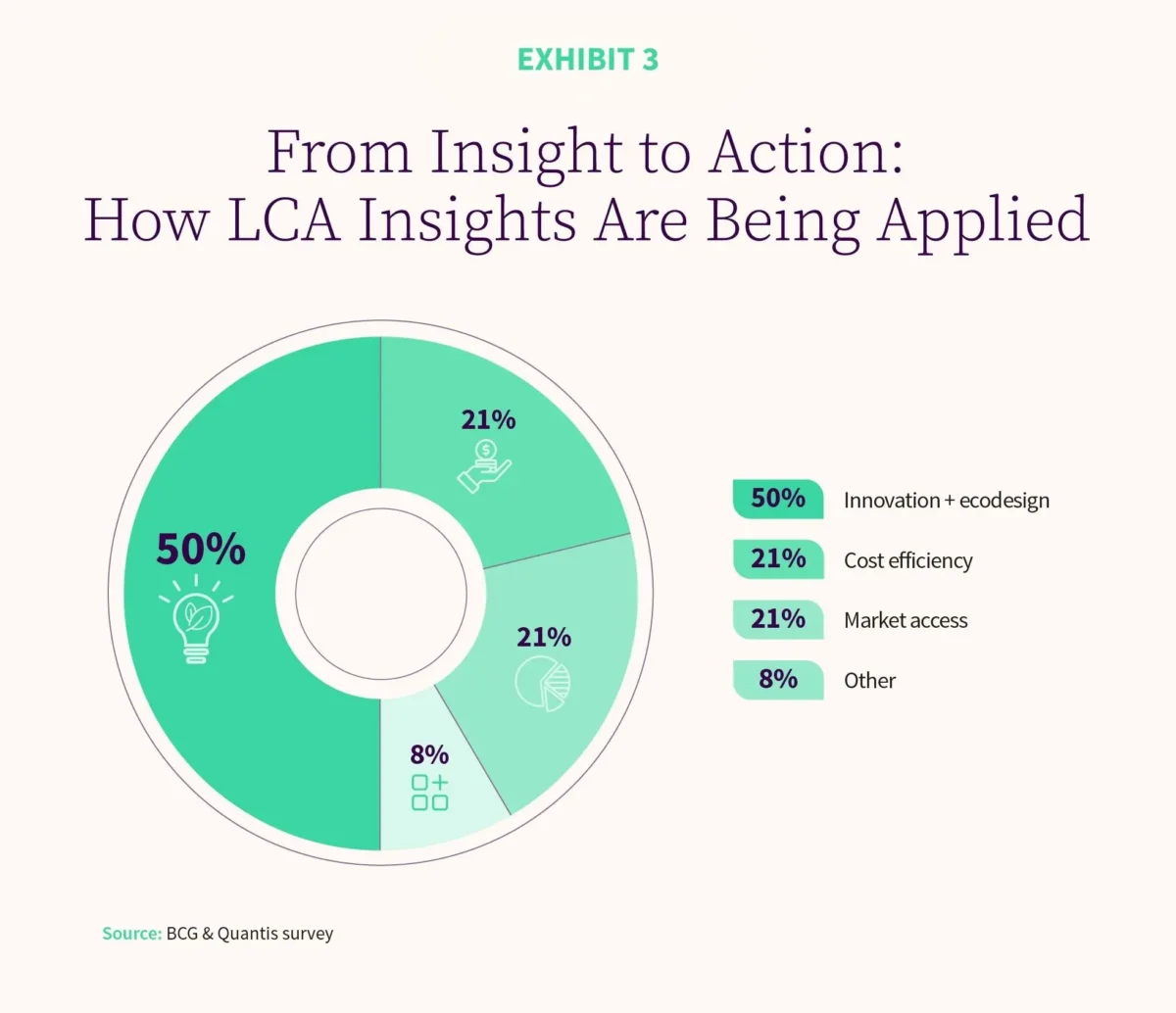
In practice, this can include optimizing solvent use, reducing material intensity, improving process efficiency, and redesigning packaging. (See: The environmental footprint of pharmaceutical manufacturing: the role of ecodesign) The actions that reduce emissions in these areas tend also to reduce cost, which is why ecodesign integrated early in development generates operational returns well beyond commercial compliance. As an example, a European manufacturer identified API as an emission hotspot and worked on innovating its production processes, piloting a new solution which showed reduction in environmental impacts (e.g. ~20% GHG emission reduction) as well as operating costs by 10%. The same insights applied after formulation decisions are locked in are, when feasible from a Marketing Authorization point of view, substantially more costly to act on. Today’s leaders are capturing these gains voluntarily. As tender requirements tighten, ecodesign will shift from competitive advantage to baseline expectation. (See Exhibit 3)
As product-level measurement matures and ecodesign becomes standard practice, the next frontier is the care pathway. Examples show that procurement systems are planning to move through strategy documents, policy guidance and technology guidance to surface environmental information. Across the full sequence of consultations, diagnostics, interventions, logistics, and follow-up that constitutes a care pathway, a product’s system-level environmental impact often diverges substantially from its individual footprint; a distinction that current health technology assessments are only beginning to capture. (See: Product impact and care pathways)
The environmental footprint of pharmaceutical products and their manufacturing spans multiple dimensions across the lifecycle, including greenhouse gas emissions, water use, waste, resource consumption, chemical pollution and ecotoxicity. Among these, carbon and ecotoxicity are increasingly prominent because they capture two of the sector’s most strategic challenges: climate pressure across an energy- and supply-intensive value chain, and the release of active pharmaceutical ingredients, excipients and derivatives that can contribute to chemical pollution and harm aquatic ecosystems during production or after patient use.
Ecodesign is a critical lever because it acts upstream, before formulation, solvent selection, delivery mechanisms, packaging choices, manufacturing processes, and sourcing options are locked in. LCA at scale provides the visibility needed to identify the most material hotspots and target intervention where it can deliver the greatest overall effect.
The care pathway, the full sequence of consultations, diagnostics, interventions, logistics, and follow-up that constitutes treatment, shapes the total environmental burden of treating a patient in ways that product-level measurement alone cannot capture. A product with a higher individual footprint may deliver lower total impact if it prevents hospitalization, shortens treatment duration, or displaces more resource-intensive interventions, while increasing quality of care.
AstraZeneca’s seasonal influenza case study, developed using the Sustainable Healthcare Coalition’s pathway methodology, makes this concrete. The average flu case generated 22.1 kg CO2e, with the majority of that impact attributable not to the medicine but to low-intensity hospital bed days. In cases like this, optimizing a product’s individual footprint while ignoring pathway impacts misses a significant part of the opportunity. Practical tools are emerging to support pathway-level analysis, including the SHC Care Pathway Carbon Calculator and AstraZeneca’s CARESA tool, which models environmental impact across disease areas and geographies. With the emergence of these methodologies and a growing need to measure environmental impact holistically — in order to allocate efforts where they matter most — companies already progressing in this space may find themselves with a head start, much as early movers in life cycle assessment built a meaningful advantage before it became standard practice.
The diversity and complexity of pharmaceutical products make standardization for measurement of their environmental performance both essential and genuinely difficult to achieve.
PAS 2090 was developed to solve that challenge. Authored by Quantis under the guidance of the British Standards Institute (BSI), and sponsored by NHS England, the UK’s Office for Life Sciences, and the Pharma LCA Consortium, PAS 2090 enables manufacturers and their partners to measure environmental impacts thus enabling informed choices about product development, packaging, logistics, and all life cycle stages. Freely accessible to all companies regardless of size, it provides a common methodological foundation for tender readiness across the industry, and a basis for transparency requests from buyers.
Pharmaceutical manufacturers face a growing body of transversal environmental regulation. Carbon pricing instruments such as Carbon Border Adjustment Mechanism (CBAM), water quality frameworks such as the Urban Wastewater Treatment Directive, and extended producer responsibility (EPR) schemes across multiple markets are creating compliance obligations that intersect directly with product and supply chain decisions. Of these, packaging is among the most immediately operational. In Europe, the Packaging and Packaging Waste Regulation (PPWR) is translating EPR principles into binding requirements on design, recyclability, recycled content, and reporting.
Pharmaceutical primary packaging and devices are exempt from several environmental regulations, including PPWR as of today, due to concern related to patient safety. Part of secondary and all tertiary packaging do not. A large number of manufacturers do not currently track packaging composition and end-of-life at the material level that regulations will require. The challenge is compounded by lead times. Packaging changes require stability testing, regulatory revalidation, and in some cases resubmission, meaning the gap between identifying a compliance issue and deploying a solution can span years, not months. Companies that have not integrated circularity into early-stage packaging design are accumulating a risk that compounds quietly until requirements arrive. By that point, the cost of catching up is substantially higher than the cost of designing right from the start.
Environmental requirements for product-level data are moving from disclosure to mandatory scoring in the most advanced markets, with more to follow. For pharmaceutical manufacturers, this is a real and growing market access challenge. The companies best placed to respond are those that have already defined what LCA must deliver for their business, built the data infrastructure to support it, and embedded ecodesign into their development processes. The returns are tangible: stronger positioning in tenders, but also lower costs and a capability that compounds in value as requirements expand.