In brief:
- CSOs are shifting from strategy to execution, with pressure to demonstrate near-term business value
- Broad sustainability agendas are diluting impact, requiring sharper focus on areas tied to cost, risk and resilience
- Value remains unclear when sustainability is not translated into financial and operational metrics
- Embedding sustainability into core functions and workflows, especially procurement, is critical to drive impact
- The CSO role is evolving into a cross-functional integrator, enabling sustainability to shape real business decisions
Chief Sustainability Officers are in the middle of an identity shift. The same leaders who secured executive buy-in, built roadmaps, and stood up sustainability functions across their organizations are being asked to prove, quickly and concretely, tangible business value.
It’s a pivotal moment, and for many, an energizing one. The shift from advocacy to action is exactly what this work has always been about. But the pressure is real. Nearly 90% of CSOs now report spending more time on regulatory compliance than they did two years ago. Budgets are under scrutiny. Timelines are compressing. And the question that keeps surfacing in boardrooms and budget reviews isn’t about vision or ambition. It is laser-focused on one thing.
“We’re three years into your plan. Where are the results?”
When Quantis published the CSO Guide in 2025, the central challenge was relevance: securing sustainability’s seat at the table and proving it belonged in core business strategy. Today, the challenge is increasingly execution and demonstrating near-term business value.
How can sustainability focus more effectively?
As sustainability has expanded in scope, many organizations are now trying to address climate, nature, circularity, supply chain and compliance at the same time. Under economic pressure and constrained resources, this breadth can dilute impact. The issue isn’t effort, but how that effort is directed.
Over time, sustainability teams have been structured to respond to a growing volume of demands, from customer requests to evolving guidance and increasing regulatory pressure. This has created a function designed to respond to everything.
A global consumer goods company saw progress stall as teams became consumed by expanding reporting requirements and data mapping efforts. As focus shifted toward measurement and compliance, momentum on core sustainability actions slowed. Resetting priorities helped redirect effort back to execution and decision-making.
When everything is treated as a priority, sustainability teams struggle to make visible progress where it matters most. Efforts remain active, but not always effective in ways the business recognizes.
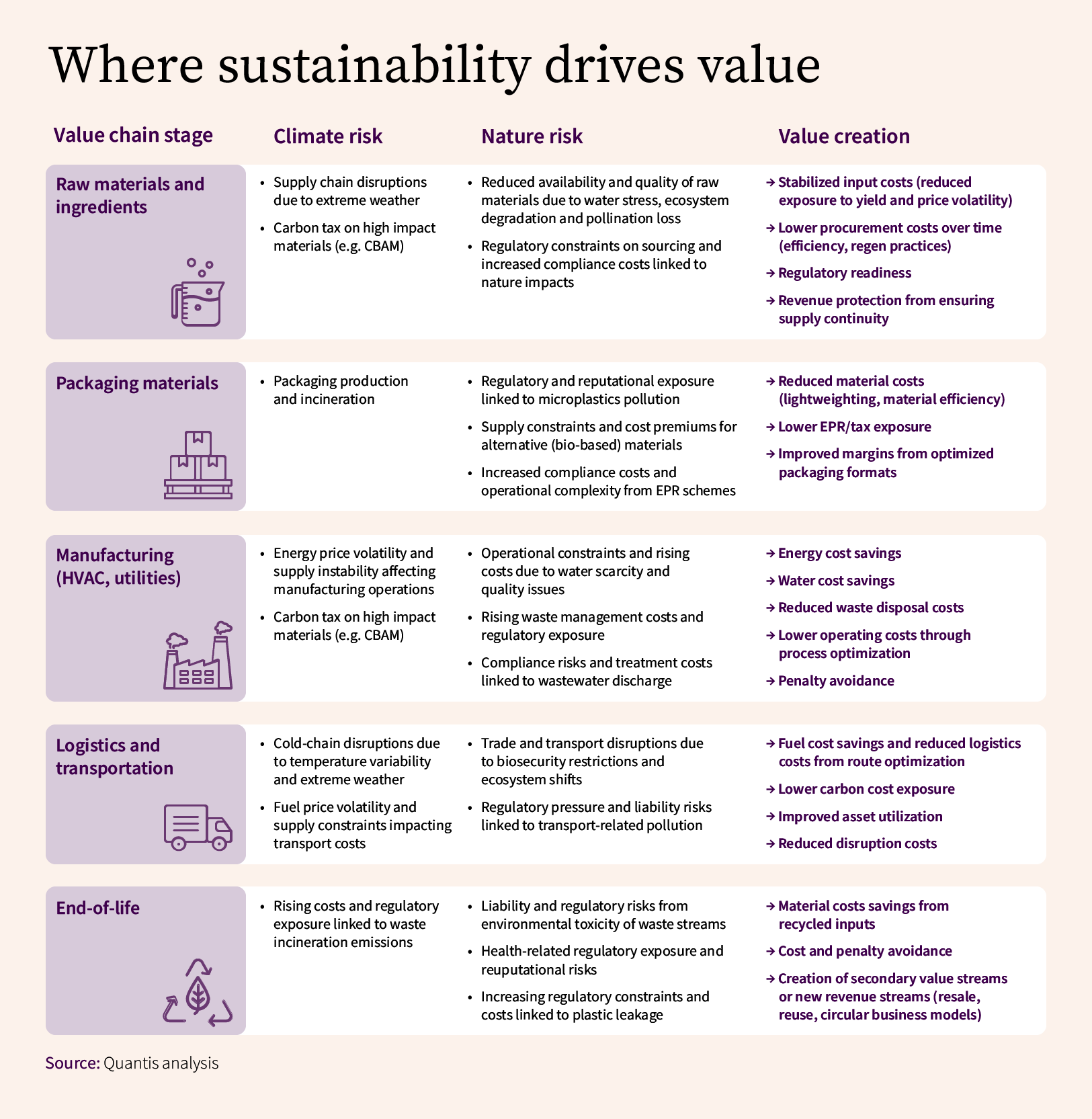
Addressing this requires a shift in how focus is defined. It is a leadership-led process, where CSOs and senior leaders guide and align teams to identify where sustainability most directly intersects with business performance, whether through cost volatility, regulatory exposure or supply chain resilience.
This means moving from responding to every request to defining where sustainability will drive the most value.
Next steps
- Identify the two or three areas where sustainability most directly affects business performance, and align resources and decision-making around them.
- Use digital tools to reduce reporting fatigue and automate lower-impact tasks, allowing teams to spend less time on data management and more on driving action.
How can sustainability show net value?
In many organizations, sustainability value remains difficult to see. Significant effort has gone into building capabilities, including carbon footprints, science-based targets, supplier engagement programs and data systems. Yet these efforts are often disconnected from the financial and operational metrics that drive decision-making.
When sustainability is not translated into cost, risk and performance, the value remains abstract, making it difficult to justify investment or influence decisions.
In one company, the business value of sustainability became clear when a risk assessment identified exposure to extreme heat at a manufacturing facility. Once translated into projected energy costs and productivity losses, a potential ~$500K exposure was reduced to ~$20K through targeted adaptation measures.
In the case below, embedding sustainability into procurement, rather than managing it in parallel, enabled a more targeted supplier strategy and reduced the cost of a decarbonization plan. By focusing on its top 20 suppliers, representing around 80% of emissions, and combining negotiations, traceability efforts and volume reallocation, the company reduced its investment from $50M to $35M, generating $15M in net value while strengthening supplier resilience.
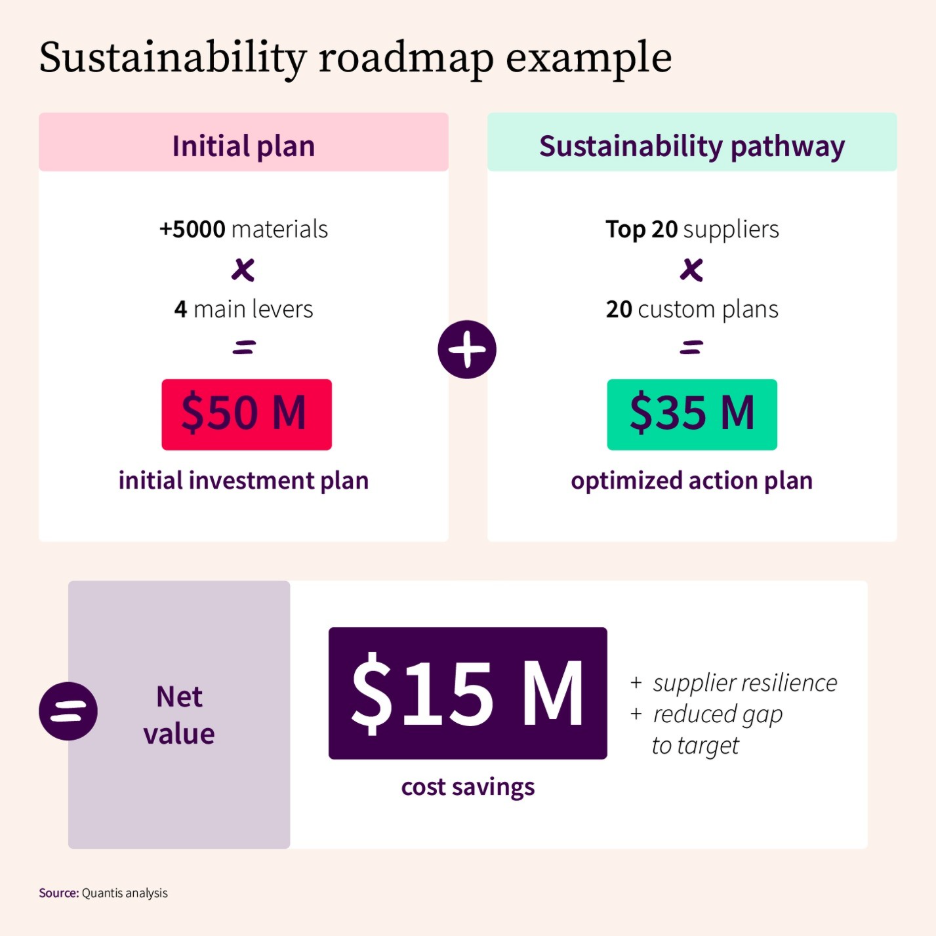
Positioning sustainability as a resilience-building capability helps close this gap, connecting environmental performance directly to the financial and operational indicators used by finance, procurement and operations teams.
Next steps
- Identify one financial or operational metric that sustainability directly influences and make that connection visible to decision-makers
- Translate environmental risks into projected financial outcomes to support investment and operational decisions
- Map sustainability initiatives to cost, efficiency and revenue impacts to make value visible across the organization
Where must sustainability show up to enable execution?
Even when priorities are clear and value is understood, impact often falls short if sustainability is not embedded where decisions are made. Sustainability increasingly surfaces in procurement, operations, finance and enterprise risk management, but without integration into these processes, it struggles to influence how the business actually runs.
For many organizations, the issue is not at the level of strategy. It sits in the processes that govern day-to-day decisions.
This is where the role of the CSO is evolving — not just as a subject matter expert, but as a cross-functional integrator, ensuring that sustainability requirements are consistently translated and applied across functions. Without this coordination, teams move in parallel rather than together, and shared capabilities fail to take shape.
Procurement teams may be responsible for collecting supplier data but lack the tools or processes to act on it. IT teams may be building data infrastructure without visibility into sustainability requirements. The systems that guide decisions were not designed to incorporate environmental criteria, creating a gap that CSOs and their teams are increasingly positioned to address across functions.
In one company, sustainability teams were working in parallel with finance and regulatory teams on a data infrastructure initiative. While each function was addressing similar needs, the lack of coordination meant efforts were duplicated and progress slowed. What should have been a shared capability became fragmented across functions, limiting its usefulness in decision-making.
Without clear success criteria or a defined purpose, sustainability data is not consistently used in decision-making. In many cases, sustainability KPIs remain confined to the sustainability function, rather than being embedded into the core metrics used by procurement, operations and other business functions.
In another company, some procurement category managers had advanced programs with strong traceability and increasingly robust data aligned to GHG accounting standards. Procurement teams were engaged and aware of sustainability — but decisions still defaulted to price and supply, with no clear knowledge or guidance on how to weigh sustainability alongside them. Data largely flowed one way (for reporting) rather than informing sourcing decisions, leading to missed opportunities to prioritize higher-impact suppliers and interventions.
Addressing this requires embedding sustainability into the workflows that already drive procurement, operational and product decisions — so it can be consistently weighed alongside price, supply and performance.
Next steps
- Map where purchasing, sourcing and product decisions are made, and integrate sustainability criteria into those workflows
- Identify where sustainability literacy and cross-functional alignment are weakest, and focus engagement there first
- Define acceptable levels of data confidence so teams can act without waiting for full precision
Looking ahead
For CSOs, the work now sits in execution.
Value becomes visible in how sustainability carries through into procurement discussions, product choices and operational trade-offs, where cost, timelines and performance shape what moves forward.
It is in these decisions that sustainability becomes real, helping the business manage trade-offs, reduce exposure and improve performance under pressure.